

Research
Research in the WET Center at Temple University is focused on a wide range of issues related to emerging contaminants and their effects on the water ecosystem. As an NSF Industry/University Cooperative Research Center, the Center’s research programs are focused on addressing challenges that are directly relevant to industry. This leads to results that can be utilized in the measurement, control, and mitigation of ECCs to benefit industry and the environment.
Examples of Research Include:
-
Analytical method development and validation
-
Assessment of alternative chemicals for environmental sustainability
-
At source and end-of-pipe treatment technologies
-
Technologies for in-situ site remediation
-
Optimization of existing municipal and industry treatment operations
-
Development of innovative and industry specific solid & hazardous waste management and treatment options
-
Water conservation and sustainability
-
Pollution prevention & green chemistry
-
Preemptive research designed to address ECCs
-
Presence and fate of ECCs in biosolids, animal manure surface and groundwater, municipal, and drinking water treatment plants
-
Water toxicology, estrogenicity, and ecological health.
Some of the treatment technologies being researched include plasma, electrooxidation, ozonation and other advanced oxidation processes, adsorption, ion-exchange, sonochemistry, chemical-selective adsorbents, and membrane and other bioreactors.
Highlighted Research Projects
01
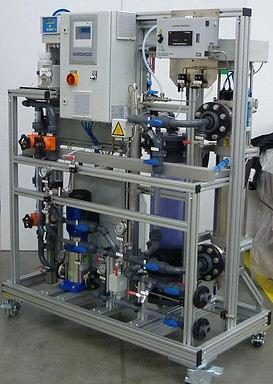
Optimization of the Ozone and UV based Advanced Oxidation Processes (AOPs) for removal of Emerging Contaminants (ECs)
With the use of a custom-built AOP pilot unit and laboratory constructed reactors, Temple WET Center team is testing and optimizing the performance of ozone and UV light based AOPs, under a variety of site operating conditions. Additional studies provided information on the sizing of UV reactors to produce high purity water for manufacturing purposes.
02
Application of polymeric resins and activated carbon as adsorbents for removal of emerging contaminants (ECs) from water
The WET Center Temple team is identifying, testing, and optimizing the operating conditions of polymeric resins and activated carbon for the selective removal of PFASs from water. These resins are regenerable, can be reused, and provide an efficient adsorption technology.

03

Developing a novel β-cyclodextrin based adsorbent for selective removal of emerging contaminants (ECs) from water and wastewater
The WET Center Temple team has developed a novel, regenerable, adsorbent for the removal of numerous ECs from water (Patented). Thin films of this adsorbent can be coated on support media such as sand, cloth, membranes, etc. The adsorbent was regenerated (Patented) and reused successfully.
04
Degradation of Antibiotic Resistance Genes (ARGs) and Inactivation of Antibiotic-Resistant Bacteria (ARBs) Using Ozone and UV-Based Advanced Oxidation Processes
The WET Center Temple team is investigating the degradation of antibiotic resistance genes (ARGs) using ozone, UV, and UV/H₂O₂-based treatment processes. Studies evaluate degradation kinetics across different gene types and forms, as well as the influence of water matrix characteristics, to assess the potential of these treatment processes to mitigate the spread of antimicrobial resistance in water.

05

Application of Electrooxidation for Removal of Short- and Long-Chain PFASs from Water
The WET Center Temple team is investigating and optimizing electrooxidation processes for the degradation of short- and long-chain per- and polyfluoroalkyl substances (PFASs) in water. Studies evaluate the effects of different operating conditions and the use of boron-doped diamond (BDD) electrodes on treatment performance, with the goal of improving PFAS degradation and advancing electrochemical treatment technologies for contaminated water.
06
Ultrasonic Degradation of Per- and Polyfluoroalkyl Substances (PFASs) in Water
The WET Center Temple team is investigating ultrasonic treatment for the degradation of PFASs in water. Studies evaluate the effects of ultrasonic frequency, power density, PFAS chain length, and argon sparging on treatment performance to optimize sonochemical degradation processes.
